Why This Certification Matters
-
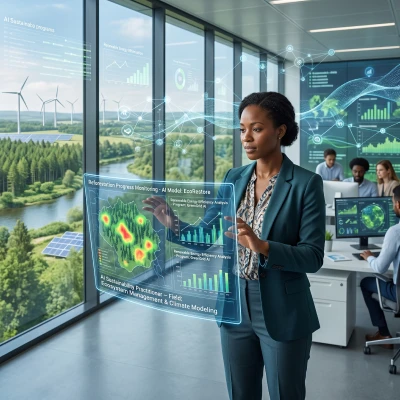
AI for Climate Modelling: Explore AI applications in climate prediction and environmental analysis.
-
Carbon Footprint Analytics: Analyse emissions data to support carbon reduction strategies.
-
Energy Optimisation: Understand AI applications in renewable energy and smart grids.
-
Sustainable Resource Management: Apply AI insights to water, waste and resource efficiency.
-
Environmental Monitoring: Explore AI tools for biodiversity and ecosystem monitoring.
-
Sustainability Strategy: Use data-driven insights to support responsible business decisions.
At a Glance: Course + Exam Overview
Who Should Enroll?
-
Sustainability and ESG professionals.
-
Environmental scientists and researchers.
-
Data analysts interested in environmental applications.
-
Renewable energy and resource management professionals.
-
Business leaders developing sustainability strategies.
-
Technology professionals interested in green AI solutions.

Skills You'll Gain
What You'll Learn
- Drive Sustainable Innovation: Harness the Power of Advanced AI
- AI for Greener Decisions: Explore carbon footprint analytics, resource optimization, and climate-impact modelling.
- Strategic Sustainability Impact: Learn to design data-driven, eco-focused frameworks that support long-term environmental goals.
- Future-Ready Tools: Includes lifecycle assessment tools, emission-tracking AI, and smart energy-management systems.
- Efficiency & Responsibility: Boost operational efficiency, reduce waste, and accelerate your organization’s journey towards a cleaner, climate-conscious future.
- 1.1 Overview of Artificial Intelligence
- 1.2 Introduction to Sustainability
- 1.3 Sustainability Challenges
- 1.4 AI for Green
- 1.5 Case Study: AI Models for Climate Change Prediction
- 1.6 Hands On: Visualizing Global CO₂ Emissions Trends with GPT
- 2.1 Introduction to Machine Learning for Sustainability
- 2.2 Supervised Learning for Environmental Impact
- 2.3 Unsupervised Learning for Environmental Insights
- 2.4 Reinforcement Learning for Sustainable Systems
- 2.5 Green AI: Sustainable AI Models
- 2.6 Hands-On
- 3.1 AI in Climate Modeling
- 3.2 AI for Renewable Energy Integration
- 3.3 Carbon Footprint Reduction
- 3.4 Case Study: Optimizing Wind Turbine Operations with AI
- 3.5 Hands-On Exercises
- 4.1 AI for Energy Optimization
- 4.2 Renewable Energy Integration
- 4.3 AI in Energy Storage and Efficiency
- 4.4 Case Study: AI-Powered Smart Grids: Optimizing Energy Distribution and Integrating Renewables
- 4.5 Hands-On Exercises: Optimizing Smart Grid Load Balancing
- 5.1 Precision Agriculture and Resource Optimization
- 5.2 AI for Pest and Disease Detection
- 5.3 Sustainable Farming and Decision Support Systems
- 5.4 Case Study: AI in Precision Agriculture
- 5.5 Hands-On: Predicting Crop Yields with Machine Learning
- 6.1 AI for Waste Sorting and Recycling
- 6.2 AI for Waste-to-Energy Solutions
- 6.3 Circular Economy and Resource Recovery
- 6.4 Case Study: AI for Waste Sorting and Recycling
- 6.5 Hands-On: Building a Waste Sorting Classifier with AI
- 7.1 AI in Remote Sensing for Environmental Monitoring
- 7.2 Wildlife Tracking and Conservation
- 7.3 AI for Ecosystem Health Monitoring
- 7.4 Case Study: AI for Deforestation Monitoring
- 7.5 Hands-On: Detecting Deforestation Using Satellite Imagery
- 8.1 AI for Water Consumption Prediction
- 8.2 AI for Smart Irrigation Systems
- 8.3 Water Quality Monitoring and Analysis
- 8.4 Case Study: AI for Smart Irrigation Systems
- 8.5 Hands-On: Optimizing Irrigation Systems with AI
- 9.1 AI in Smart City Infrastructure
- 9.2 Sustainable Mobility and Transportation
- 9.3 AI in Urban Resource Optimization
- 9.4 Case Study: AI for Urban Air Quality Monitoring
- 9.5 Hands-On: Optimizing Traffic Flow and Reducing Emissions with AI-Driven Smart Traffic Management
Tools You'll Master
Prerequisites
- Basic understanding of artificial intelligence concepts.
- Awareness of sustainability and environmental challenges.
- Data analysis and interpretation skills.
- Familiarity with environmental science and sustainability frameworks.
- Programming knowledge in Python or a similar language.
Exam Details
Duration
Passing Score
Format
Delivery Method
Exam Blueprint:
- Introduction to AI and Sustainability – 5%
- AI Techniques for Sustainability Solutions - 11%
- AI for Climate Change Mitigation – 12%
- AI in Sustainable Energy Systems - 12%
- AI for Sustainable Agriculture - 12%
- AI in Waste Management and Circular Economy - 12%
- AI for Biodiversity Conservation and Environmental Monitoring - 12%
- AI for Water Resource Management - 12%
- AI for Sustainable Cities and Smart Urban Development – 12%
Choose the Format That Fits Your Schedule
What's Included (One-Year Subscription + All Updates):

- High-Quality Videos, E-book (PDF & Audio), and Podcasts
- AI Mentor for Personalized Guidance
- Quizzes, Assessments, and Course Resources
- Online Proctored Exam with One Free Retake
- Comprehensive Exam Study Guide
- Access for Tablet & Phone
- 1 day (live or virtual) Self-Paced: 8 hours of content
- Real-time Q&A, peer collaboration, and hands-on labs
- Led by AI Certified Trainers and delivered through Authorized Training Partners
- 8 hours of content
- Learn anywhere, anytime, with modular quizzes to track progress
Need More Flexibility?
To help you along your way, we can help you set up a customizable payment plan. Just book a call, we’ll provide you with the details!
Let's Arrange a Call9/10 of our learners achieve their learning objectives after successful completionProcess Advisors

Frequently Asked Questions
The AI+ Sustainability Practitioner™ certification explores how artificial intelligence can address environmental challenges through climate modelling, emissions analysis, energy optimisation, waste management and sustainable resource planning.
AI can analyse environmental data, forecast energy demand, monitor emissions, optimise resource consumption and identify patterns in climate and ecosystem data. These insights can help organisations make better-informed sustainability decisions.
The programme lists programming skills as a prerequisite, with Python or a similar language recommended. Familiarity with AI, data analytics, environmental science and sustainability issues will also help you understand the course material.
This certification can support professional development in AI-enabled sustainability, environmental data analysis, resource management, green technology and sustainable business operations. Specific job opportunities depend on your previous qualifications and experience.
Environmental scientists, sustainability managers, ESG professionals, data analysts, renewable energy specialists and business leaders can benefit from learning how AI supports environmental monitoring and sustainable decision-making.
Recommended Certifications
Explore our hand-picked certifications trusted by industry leaders. Compare career paths, exam details, and salary insights to find the credential that matches your goals and accelerates your growth.