Home » Smart Recruitment » How to Use LinkedIn to Get IT Job Offers Faster 

How to Use LinkedIn to Get IT Job Offers Faster 

by Maaz Tariq
LinkedIn for IT jobs shown on a laptop in a modern workspace

Key Takeaways 

  • LinkedIn accelerates IT job offers when strategy replaces random applications. 
  • Profile optimisation positions you for recruiter searches automatically. 
  • Networking opens hidden roles faster than job boards ever can. 
  • Personalised recruiter outreach dramatically boosts response rates. 
  • Fortray programs convert LinkedIn effort into guaranteed job outcomes. 

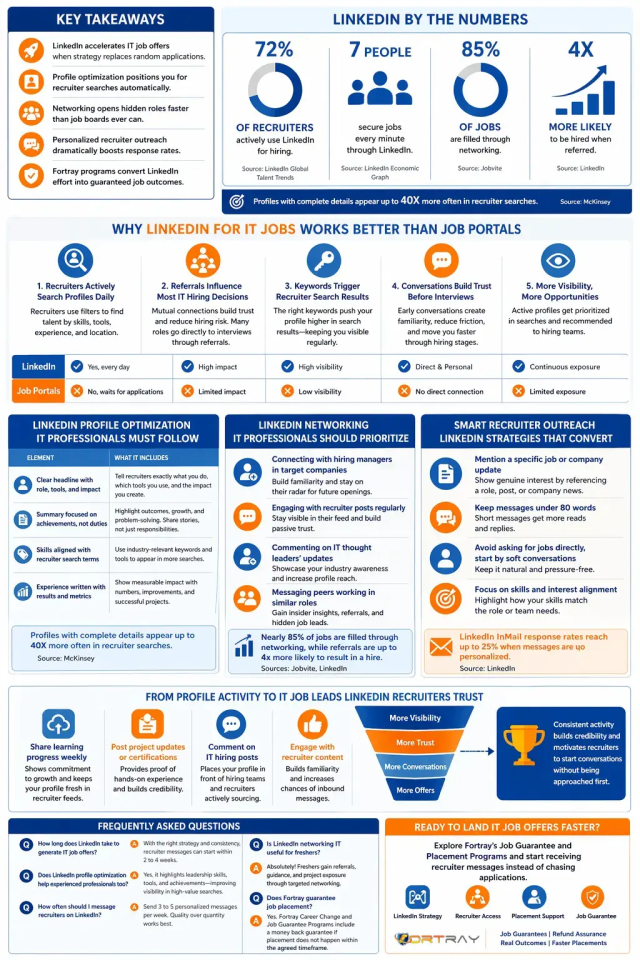
LinkedIn plays a massive role in IT hiring today. In fact, over 72% of recruiters actively use LinkedIn for hiring, and 7 people secure jobs every minute through the platform. This reality proves one thing clearly. If you want faster results, you need LinkedIn to work for you, not against you. When people start exploring LinkedIn for IT jobs, many focus only on the “Apply” button. However, offers rarely come from applications alone; instead, they come from visibility, trust, and conversations. LinkedIn rewards professionals who show clarity and consistency rather than desperation. 

Furthermore, recruiters do not browse job portals all day, they search LinkedIn profiles actively. As a result, your presence matters more than your application volume. LinkedIn for IT jobs creates opportunities even when you sleep. At Fortray, candidates enrolled in their Placement Program learn how to attract recruiters instead of chasing them. This structured approach reduces job search timelines dramatically and increases offer quality.
How to Use LinkedIn to Get IT Job Offers Faster? Source: LinkedIn

Why LinkedIn for IT jobs Works Better Than Job Portals 

LinkedIn for IT jobs works because recruiters treat the platform as their primary talent database. Unlike job portals, LinkedIn lets recruiters quickly assess skills, recent activity, technical interests, and even communication style. This immediate insight helps them shortlist faster and with more confidence. Additionally, LinkedIn supports passive hiring. Many companies start shortlisting candidates even before publishing job openings. As a result, professionals who stay active and visible often gain access to opportunities earlier than others. 

Fortray’s Career Change Programs train candidates to appear consistently in recruiter searches rather than occasionally. This visibility builds momentum over time and keeps profiles circulating within hiring pipelines. Here’s why LinkedIn beats job portals: 

Recruiters actively search profiles daily 

Recruiters do not wait for applications on LinkedIn. They actively use filters to search profiles by skills, tools, experience level, and location. This behavior allows them to discover candidates faster than job portals. When your profile stays optimized and active, it repeatedly shows up in recruiter searches without extra effort. 

Referrals influence most IT hiring decisions 

LinkedIn highlights mutual connections, which helps recruiters trust candidates quickly. Referrals reduce hiring risk and speed up screening decisions. Many IT roles move directly to interviews when someone inside the company vouches for a candidate. LinkedIn makes these referral pathways visible and easy to access. 

Keywords trigger recruiter search results 

Recruiters rely heavily on keyword-based searches to find candidates. When your profile includes relevant tools, technologies, and job titles, LinkedIn pushes it higher in results. Job portals rarely offer this level of search precision. Strategic keyword placement keeps your profile circulating regularly. 

Conversations build trust before interviews 

LinkedIn enables direct conversations long before interviews begin. Messages, comments, and engagement help recruiters recognize your name and communication style. This early familiarity lowers screening friction. As a result, interview calls feel warmer and move faster through hiring stages. 

Moreover, LinkedIn favors profiles that look current and active. Even small actions like profile updates, comments, or posts improve visibility in search results. Because of this, a focused LinkedIn job search strategy often delivers interviews much faster than submitting hundreds of applications on job portals. 

Build Your Career with Fortray Global Services

Candidates Looking for New Roles

A Safe Way towards Your Next Career Move. Secure the roles based on your expertise and skills 

What You Get:

Why It Matters:

Find the right role faster and set the foundation for long-term career growth. 

Work with Consultant

Expert Guidance, Better Opportunities. Ensure personalized support throughout your job search 

What You Get:

Why It Matters:

Get the expert guidance to help you secure the right role with confidence.

LinkedIn Profile Optimization IT Professionals must follow 

Your LinkedIn profile works like a landing page for recruiters. If it fails to communicate value quickly, everything else breaks down. That’s why LinkedIn profile optimization IT strategies must focus on clarity first and visual polish second. Recruiters scan profiles in seconds, so your message must land immediately. When your profile feels clear and purposeful, outreach and networking become far more effective. 

At Fortray’s IT Placement Support, we guide candidates to position themselves as solution providers rather than job seekers. This shift changes how recruiters perceive profiles instantly. Instead of seeing someone “looking for work,” they see someone ready to add value from day one. That positioning increases interview callbacks significantly. What optimized profiles include: 

Clear headline with role, tools, and impact 

A strong headline tells recruiters exactly what you do and which tools you use. It also hints at the impact you create, such as performance improvement or system scalability. This clarity helps recruiters decide relevance in seconds, and as a result, they click through instead of scrolling past. 

Summary focused on achievements, not duties 

An effective summary highlights results, growth, and problem‑solving skills. It explains how you contribute rather than listing job responsibilities. Recruiters respond better to stories of outcomes and learning, and this approach builds credibility fast. 

Skills aligned with recruiter search terms 

Recruiters rely heavily on keyword searches to find candidates. When your skills match industry tools and hiring language, your profile appears more often. This alignment keeps your profile circulating in searches regularly, and it also supports long‑term visibility. 

Experience written with results and metrics 

Experience sections that show measurable impact gain more trust. Numbers, improvements, and completed projects stand out clearly. Recruiters understand your contribution without guessing, and this clarity speeds up screening decisions. 

Additionally, profiles with complete details appear up to 40 times more often in recruiter searches, according to McKinsey. That single stat explains why optimisation drives results so strongly. Visibility directly influences opportunity volume, and a strong LinkedIn job search strategy always begins here. Outreach messages and networking efforts only succeed when your profile instantly builds trust. When recruiters feel confident after one profile visit, interviews follow much faster. 

LinkedIn Networking IT Professionals Should Prioritize 

Networking does not mean collecting random connections or sending mass requests. Instead, LinkedIn networking for IT professionals should focus on relevance, intent, and shared value to build meaningful relationships. The real impact comes from knowing how to start conversations that feel genuine rather than transactional, this is what helps candidates stand out in crowded networks.

This approach is not just a preference; it’s backed by data. Studies show that nearly 85% of jobs are filled through networking, while referrals are up to 4x more likely to result in a hire compared to cold applications. On LinkedIn, candidates who actively engage with content and maintain meaningful interactions are significantly more visible to recruiters, as the platform’s algorithm prioritizes active and relevant profiles. Over time, this purposeful approach ensures recruiters remember them early and turns simple connections into referrals and interview opportunities. Effective networking actions include:

Connecting with hiring managers in target companies 

Hiring managers influences interview decisions directly. Connecting with them helps you understand team needs and company priorities early. Even silent visibility builds familiarity over time, and when roles open, recognizable profiles gain attention first. 

Engaging with recruiter posts regularly 

Recruiters notice consistent engagement quickly; by commenting thoughtfully on hiring or industry posts keeps your profile appearing in their feed. This visibility builds trust passively. Eventually, recruiters reach out without prompting. 

Commenting on IT thought leaders’ updates 

IT leaders shape conversations around tools, trends, and hiring needs. Engaging with their content shows curiosity and industry awareness. These interactions also increase profile reach. Recruiters often follow the same voices. 

Messaging peers working in similar roles 

Peers share insights, referrals, and interview experiences openly. Conversations with peers feel natural and pressure‑free. Over time, these connections introduce you to hidden opportunities. Peer networks often move faster than formal applications.  Because relationships strongly influence hiring decisions, networking often generates IT job leads LinkedIn users never see posted publicly. Many roles close through referrals or direct outreach alone. As a result, focused networking shortens the job search cycle dramatically and improves offer quality. 

Smart Recruiter Outreach LinkedIn Strategies That Convert 

Most people message recruiters the wrong way. Generic templates fail quickly because recruiters see them every day. Recruiter outreach LinkedIn works only when messages feel relevant, respectful, and intentional. Fortray trains candidates through its Job Guarantee and Placement Coaching Program to personalize every outreach without overthinking or sounding pushy. 

High-response outreach principles: 

  • Mention a specific job or company update by referencing a role. Mainly through a post, or company news shows genuine interest and proves you researched before reaching out. 
  • Keep messages under 80 words as short messages respect recruiters’ time and increase the chance of being read fully. 
  • Avoid asking for jobs directly, start by soft conversations to feel natural and remove pressure, which keeps recruiters open to responding. 
  • Focus on skills and interest alignment by highlighting how your skills match the role or team rather than asking for favors. 

LinkedIn InMail response rates reach up to 25% when messages feel personal. This statistic clearly shows why thoughtful messaging matters. Therefore, quality always beats quantity in recruiter outreach LinkedIn efforts, and fewer well-written messages often create stronger pipelines than mass outreach. 

Build Your Career with Fortray Global Services

Advance Your Career with The Right Experts

Exclusive roles in high-demand sectors, including IT, tech, cloud, cybersecurity & data, and more! 

Join the Global IT Talent Network at Fortray 

From Profile Activity to IT Job Leads LinkedIn Recruiters Trust

Activity matters as much as messaging on LinkedIn. Recruiters judge profiles by engagement and consistency, and many IT job leads LinkedIn users gain come from visible activity. Regular engagement signals growth and readiness. Fortray’s IT Job Placement Support helps candidates stay visible through focused, high‑impact actions that build recruiter trust and improve profile ranking over time. 

Effective activity includes: 

  • Sharing learning progress weekly by posting learning updates shows commitment to growth and keeps your profile fresh in recruiter feeds. 
  • Posting project updates or certifications. These updates provide proof of hands‑on experience and make your profile feel credible and current. 
  • Commenting on IT hiring posts with a thoughtful comment. This places your profile directly in front of hiring teams and recruiters actively sourcing. 
  • Engaging recruiter content by consistent interaction builds familiarity and increases the chance of inbound recruiter messages. 

Active profiles look current, confident, and credible to recruiters. This credibility often motivates recruiters to start conversations without being approached first. As a result, interview discussions begin faster and offers move through hiring stages more smoothly. 

How Fortray Can Help You?

LinkedIn Focus AreaHow Fortray HelpsOutcome for IT ProfessionalsLearn More
Profile OptimizationHelps candidates build recruiter-ready profiles (headline, keywords, achievements, metrics)Higher visibility in recruiter searches and stronger first impressionsJob Placement Support
Networking StrategyTrains candidates to connect with hiring managers, peers, and industry professionals effectivelyAccess to hidden job opportunities and referral-based hiringNetworking Strategy
Recruiter OutreachProvides structured guidance on writing personalized, high-response recruiter messagesIncreased response rates and faster interview callbacksRecruiter Outreach
LinkedIn Activity BuildingCoaches on consistent posting, engagement, and visibility strategiesImproved profile ranking and inbound recruiter messagesProfile Optimization
Job Placement SupportEnd-to-end career guidance including LinkedIn strategy + interview preparationFaster job acquisition with structured placement supportJob Placement Support
Career Change ProgramsSupports non-IT and IT professionals transitioning into high-demand rolesSmoother entry into IT careers with guided roadmapCareer Change Programs

Conclusion 

LinkedIn for IT jobs works fastest when strategy replaces guessing. A strong profile, smart networking, consistent activity, and targeted outreach create predictable results over time. When these elements work together, they reduce dependency on random applications. However, the right guidance accelerates execution and helps avoid costly trial-and-error. 

Fortray Career Change and Job Guarantee Programs support IT professionals through career transitions with job guarantees and refund assurance if no placement happens. Our career change programs focus on real hiring outcomes, not surface-level promises. We combine LinkedIn strategy, recruiter access, and placement support to shorten hiring cycles. This approach helps candidates convert LinkedIn activity into reliable offers that last. 

Ready to land IT job offers faster? Explore Fortray’s Job Placement Support and start receiving recruiter messages instead of chasing applications. 

Frequently Asked Question 

1. How long does LinkedIn take to generate IT job offers?

The timeline depends heavily on strategy and consistency. Profiles that follow a clear structure, strong keywords, and regular activity often start receiving recruiter messages within 2 to 4 weeks. Without strategy, results usually take much longer.

2. Does LinkedIn profile optimization help experienced professionals too?

Yes, experienced professionals benefit significantly from optimization. Recruiters search for leadership skills, tools, and achievements, not just job titles. A well‑optimized profile highlights senior‑level impact and improves visibility in high‑value searches.

3. How often should I message recruiters on LinkedIn?

Messaging too often hurts results. Instead, sending 3 to 5 personalized messages per week works best. This approach protects quality, avoids spam signals, and keeps conversations meaningful for recruiters.

4. Is LinkedIn networking IT useful for freshers?

Absolutely. Freshers gain referrals, guidance, and project exposure through targeted networking. Many entry‑level IT roles close through conversations rather than formal postings, making LinkedIn especially valuable early in careers.

5. Does Fortray guarantee job placement?

Yes. Fortray Career Change and Job Guarantee Programs include job guarantees with a money back guarantee if placement does not happen within the agreed timeframe. This structure ensures accountability and outcome‑focused career support.

You may also like