Cybersecurity UK Job Market Report: Trends, Insights, and Statistics [August 2026]

An up-to-date snapshot of the UK’s cybersecurity job market for summer 2026, covering salaries, workforce size, the skills gap, breach data and live hiring demand. It draws on DSIT and Home Office research, ITJobsWatch, Morgan McKinley, Indeed UK and Glassdoor UK. Figures are current as of August 2026.

WHAT’S INSIDE THIS REPORT? QUICK ACCESS:

Median cyber security salary

£60,000
+4.35% YoY
Median across all UK roles citing cyber security skills, against a whole-economy median of roughly £31,600.

UK cyber workforce

143K
+5% in 2024
DSIT’s whole-economy estimate, driven largely by a 20% rise in cyber security graduates.

Businesses breached in 2025

43%
Flat YoY
Revenue of the UK cyber security sector, up from £8.9 billion in 2020.

Cyber sector revenue

£14.7bn
+11% YoY
Revenue of the UK cyber security sector, up from £8.9 billion in 2020.

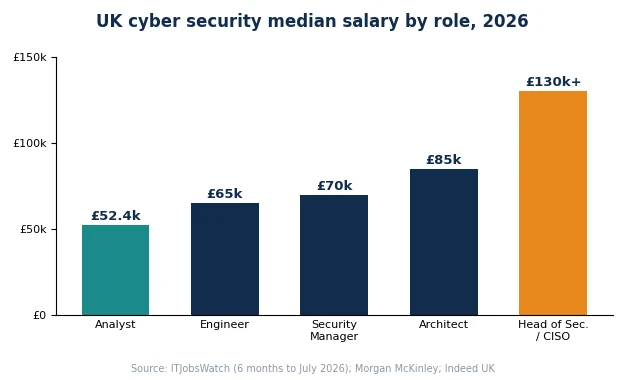
Cybersecurity roles pay a median £60,000, from £52.4k for analysts to £130k+ for CISOs

Cybersecurity remains one of the best-paid corners of UK tech, and pay climbs steeply with seniority: the gap between a junior analyst and a security architect is now wider than the median UK salary itself. The median salary across all UK roles citing cyber security skills is £60,000, up 4.35% year on year and comfortably above the UK’s whole-economy median pay of roughly £31,600 (ONS, 2025).4 The figures below are UK medians for permanent roles in the six months to July 2026.
This image shows a bar graph with the cybersecurity job salaries by role in the UK for the year 2026.

Median benchmark

Medians run from £52.4k for analysts (typical range £31k–£72k) and £65.0k for engineers (£45k–£85k) to £70.0k for security managers (£50k–£95k) and £85.0k for architects (£65k–£130k).

Entry-level vs senior cap

Entry-level roles such as SOC analyst and junior penetration tester typically start at £28,000–£40,000. At the top end, Head of Security / CISO roles have a median of £130k+ and a typical range of £100k–£180k+.

Location & certification premium

London roles pay 10–20% more than the UK average; Indeed puts the London cyber security average at £51,296, around 17% above the national figure.6 OSCP and CISSP holders routinely command five-figure uplifts over uncertified peers, while CompTIA Security+ and CEH remain the most common baseline requirements in job adverts.
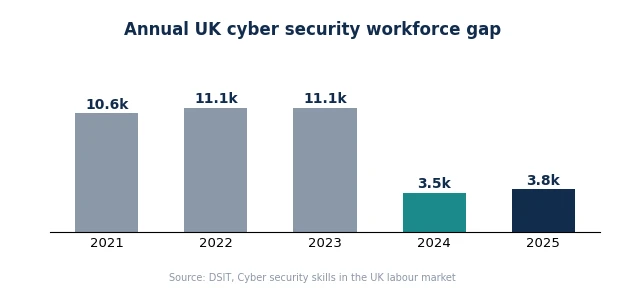
The UK cyber workforce reached 143,000 while the annual skills gap narrowed to 3,800

Alongside the 143,000-strong whole-economy workforce sits a narrower figure: people employed specifically by firms that sell cyber security products and services. DSIT tracks this separately in its annual Sectoral Analysis, the eighth edition of which was published in May 2026. Sector revenue rose 11% year on year to £14.7 billion, gross value added rose 17% to £9.1 billion, and the number of active firms rose 20% to 2,603, while full-time-equivalent employment grew just 3% to 69,600. Employment growth of 3% is the slowest recorded since the series began in 2018, even as firm count jumped 20% and GVA rose 17%. Revenue and productivity are climbing faster than headcount (GVA per employee is £131.2k, up 13%), a sign that AI-assisted tooling and consolidation, not just hiring, are driving sector growth. Sector investment reached £184 million across 47 deals in 2025, and most firms are small: 58% micro, 19% small and just 22% medium or large, against around 3% of the wider UK business population. Don’t confuse the two headline workforce figures: 143,000 is the whole-economy estimate, including in-house security staff at banks, retailers and government bodies, while 69,600 counts only people employed directly by dedicated cyber security firms.
Bar chart showing the annual UK cyber security workforce gap from 2021 to 2025. The gap was 10.6k in 2021, increased to 11.1k in 2022 and remained at 11.1k in 2023, before dropping to 3.5k in 2024 and slightly rising to 3.8k in 2025. Source: DSIT, Cyber security skills in the UK labour market.

143,000 people

DSIT estimates the UK cyber security workforce reached 143,000 people in 2024, growing 5% that year, up from 2% growth in 2022, driven largely by a 20% rise in the number of cyber security graduates.

Narrowed Gap

The annual workforce gap has narrowed from 11,100 in 2022/23 to 3,800 in the most recent report.1 ISC2 puts the UK’s skills gap at roughly 93,000 using a global workforce-demand model. Both figures are correct because they measure different things, so always check the methodology before comparing.

Diversity in the profession

Only 17% of cyber security professionals are women, against 48% of the UK workforce overall. Just 8% report a disability, and while 19% are from an ethnic minority background, only 8% of that group hold senior roles.
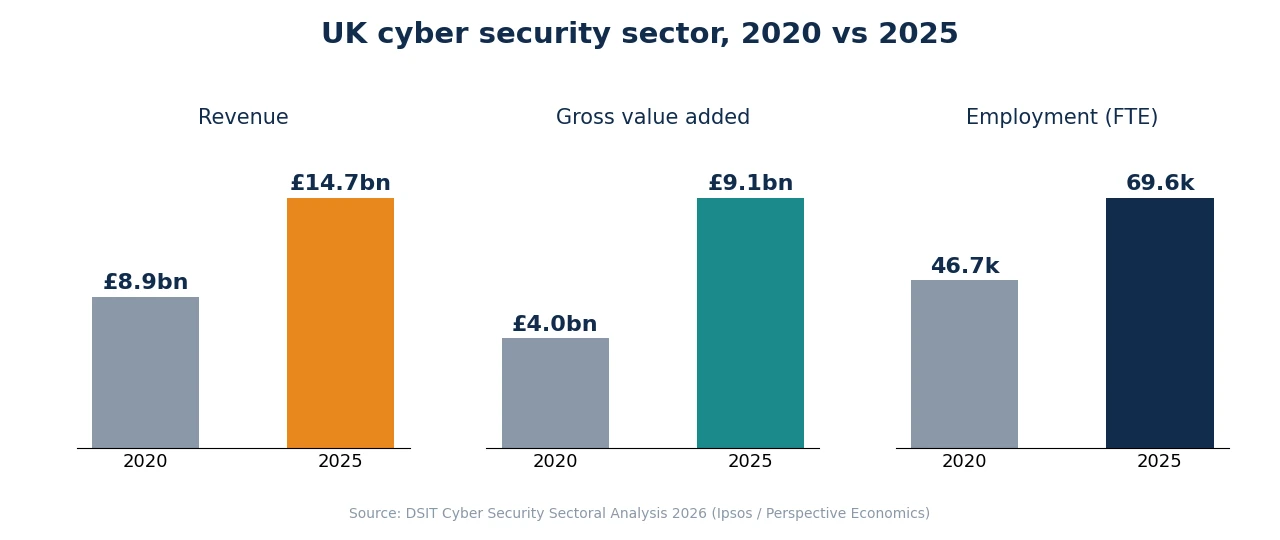
The UK cyber security sector generated £14.7 billion in revenue in 2025, up from £8.9 billion in 2020

Alongside the 143,000-strong whole-economy workforce sits a narrower figure: people employed specifically by firms that sell cyber security products and services. DSIT tracks this separately in its annual Sectoral Analysis, the eighth edition of which was published in May 2026. Sector revenue rose 11% year on year to £14.7 billion, gross value added rose 17% to £9.1 billion, and the number of active firms rose 20% to 2,603, while full-time-equivalent employment grew just 3% to 69,600. Employment growth of 3% is the slowest recorded since the series began in 2018, even as firm count jumped 20% and GVA rose 17%. Revenue and productivity are climbing faster than headcount (GVA per employee is £131.2k, up 13%), a sign that AI-assisted tooling and consolidation, not just hiring, are driving sector growth. Sector investment reached £184 million across 47 deals in 2025, and most firms are small: 58% micro, 19% small and just 22% medium or large, against around 3% of the wider UK business population. Don’t confuse the two headline workforce figures: 143,000 is the whole-economy estimate, including in-house security staff at banks, retailers and government bodies, while 69,600 counts only people employed directly by dedicated cyber security firms.
Three side-by-side bar charts compare key metrics for the UK cyber security sector in 2020 and 2025. Revenue increased from £8.9 billion in 2020 to £14.7 billion in 2025. Gross value added rose from £4.0 billion to £9.1 billion. Employment increased from 46.7 thousand full-time equivalent (FTE) jobs to 69.6 thousand. Source: DSIT Cyber Security Sectoral Analysis 2026 (Ipsos / Perspective Economics).

Nearly half of UK businesses now report an incident-response skills gap, up from 27% in 2020

Skills gaps in UK cyber security are persistent and span both basic and advanced work. DSIT’s research finds that around half of businesses lack basic technical skills such as firewall setup and malware removal, 30% report gaps in advanced skills, and the share reporting an incident-response gap has risen sharply since 2020. AI is adding a new layer. For the first time, DSIT’s 2026 labour-market research and the Breaches Survey both dedicated substantial sections to AI, as both a productivity tool for security teams and a new source of risk: 53% of cyber security businesses report staff already using AI tools in daily work, 65% expect their need for AI-related skills to increase over the next year, and only 42% say staff have received any formal AI training. Roughly a third of all UK businesses are using, adopting or considering AI, but only 24% of that group have cyber security practices in place to manage the risk. That gap between AI adoption and AI governance is emerging as one of the fastest-growing niches in UK hiring, alongside cloud security and OT/critical-infrastructure security.

01

Basic technical skills gap

UK businesses reporting gaps in basic technical skills, such as firewall setup and malware removal.

Listed in

49%

02

Advanced skills gap

Businesses reporting gaps in advanced skills, such as penetration testing and forensic analysis.

Listed in

30%

03

Incident-response gap

Businesses reporting an incident-response skills gap, up from 27% in 2020.

Listed in

48%

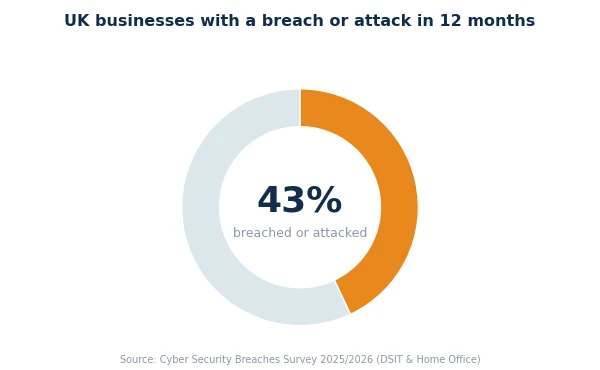
43% of UK businesses identified a breach or attack in the last 12 months

Hiring demand is ultimately a function of risk. The Cyber Security Breaches Survey 2025/2026, based on interviews with 2,112 businesses and 1,085 charities, is the clearest picture of how exposed UK organisations are. The 43% figure (about 612,000 businesses) is flat year on year and down from 50% two years ago, but exposure rises with size: 42% of micro businesses, 46% of small, 65% of medium and 69% of large businesses identified a breach or attack. An estimated 5.19 million cyber crimes were committed against UK businesses over the year, and 31% of businesses now place cyber security responsibility at board level, up from 27%.
Donut chart showing that 43% of UK businesses experienced a cyber security breach or attack within the previous 12 months. The highlighted orange segment represents the affected businesses, while the remaining light grey segment represents businesses that did not report a breach or attack. Source: Cyber Security Breaches Survey 2025/2026 (DSIT & Home Office).

Phishing dominates

Phishing was experienced by 38% of businesses and named the most disruptive attack type by 69% of those affected, followed by impersonation (10%), malware (7%), denial of service (3%) and ransomware (1%).

Rare but costly

Ransomware hit just 1% of businesses (down from 3%) but remains disproportionately damaging. The share of breaches resulting in lost revenue or share value more than doubled from 2% to 5%, yet only 25% of businesses have a formal incident-response plan and just 5% hold Cyber Essentials certification.

Over 1,100 cyber security roles are open on Indeed UK, with London and the South East paying the most

This snapshot of open UK vacancies across major job boards was taken in August 2026. Job-board counts fluctuate daily and overlap across platforms, so treat them as directional rather than a single unduplicated total. Regional hiring remains concentrated but is spreading: London and the South East still command the largest share and the highest pay, with finance, banking and central government the biggest employers, while Manchester, Birmingham, Leeds, Bristol and Edinburgh have all built genuine regional clusters as organisations stand up distributed security operations centres. Hybrid working has widened access to roles outside the traditional hubs, though senior SOC and incident-response leadership positions still skew toward major cities. Sector-wide vacancy volumes are reported up roughly 11% year on year.
Highest volume
1,173

Source: Indeed UK, August 2026

The largest of the three job boards sampled, reflecting the concentration of demand in London and the South East.
Source: Indeed UK, August 2026
Job board
1,074

Open roles on Glassdoor UK

A second large pool of listings, with counts that overlap with Indeed UK and CWJobs.
Source: Glassdoor UK, August 2026
London hub
918

Open roles on CWJobs

Of the 918 roles listed, 225 are based in London, with the rest spread across regional clusters and remote or hybrid positions.
London roles: 225

A market that has matured rather than cooled

The raw people-shortage that dominated headlines a few years ago (11,100 short in 2022) has narrowed to 3,800, but breach rates haven’t fallen to match, boards are taking the risk more seriously than ever, and AI is simultaneously raising the skills bar and creating a new specialism in AI governance and security. Sector revenue and productivity are growing faster than headcount, which points to rising pay for specialised, higher-skill roles even as overall job growth moderates. For anyone assessing a move into the field, the throughline across every 2026 report is the same: generalist entry-level competition is intensifying, while specialist, cloud, AI-security and incident-response skills remain the areas where the UK is still visibly short. All figures are drawn from named primary or industry sources published in 2026 unless otherwise stated, including DSIT, the Home Office, ITJobsWatch, Morgan McKinley, Indeed UK, Glassdoor UK and CWJobs. Where two credible sources report different numbers for the same metric, both are shown with their methodology noted rather than silently picking one. Cyber security statistics update at least annually, so check gov.uk for the latest edition of any DSIT report before citing figures beyond 2026.
THE FOLLOWING ROLES ARE REFERENCED IN THIS ANALYSIS:

Cyber Security Analyst

Cyber Security Engineer

Security Manager

Cyber Security Architect

Head of Security / CISO

SOC Analyst

Junior Penetration Tester

Security Architect

Incident Response Specialist

AI Security

Role data source: ITJobsWatch job-market statistics for permanent UK jobs citing Cybersecurity, six months to 7 October 2026. “Cybersecurity” appeared in 6,545 of the permanent UK job advertisements (5.56%), with a median annual salary of £60,000. itjobswatch.co.uk

Use Job Market Insights to Plan Your Career in Tech or AI

Understand where the opportunities are and find the right route into IT or AI based on your skills, experience and career goals. 

Hear it from our Alumni

Contact Us

Get in Touch with our team

Ready to explore a career in IT? Speak to our team about the right programme and pathway for your goals. 

Admissions Hotline

+44 207 9934928

Average Response Time

Within 2 business hours

Submit your inquiry

Please fill out all required fields to help us route your request.

By submitting, you agree to our Privacy Policy and consent to receive admissions emails.