Artificial Intelligence UK Job Market Report: Trends, Insights, and Statistics [August 2026]

An up-to-date snapshot of the UK’s fast-moving AI job market for summer 2026, drawing on ITJobsWatch, PwC, Indeed Hiring Lab, ManpowerGroup, ONS and UK Government data. Figures are current as of July–August 2026.

WHAT’S INSIDE THIS REPORT? QUICK ACCESS:

AI skills salary median

£71,000
+29% vs tech
Median for permanent roles citing AI skills, against £55,000 across all process-and-methodology tech roles.

Specialist AI postings

+61%
112K → 180K
Year-on-year growth in 2025, while overall UK vacancies fell 6.6%.

Postings mentioning AI

5.6%
Highest of 30
Share of UK organisations reporting at least one AI-related skills gap.

Orgs with an AI skills gap

97%
Hardest skill
Share of UK organisations reporting at least one AI-related skills gap.

AI-skilled roles pay a median £71,000, 29% above the wider tech median

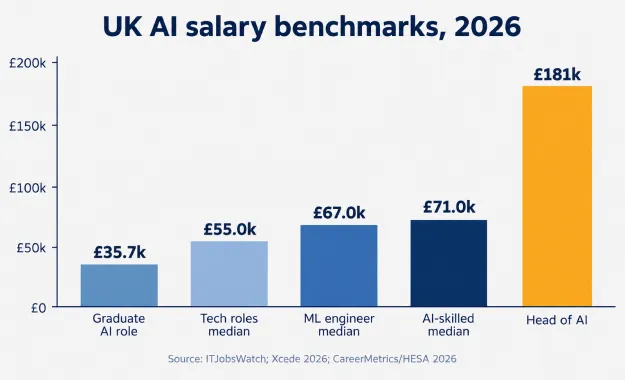
AI continues to be one of the highest-paying and fastest-growing specialisms in UK tech, even as the wider graduate and entry-level jobs market cools. Salaries for AI-skilled roles are pulling further ahead of the rest of the sector in 2026: the median for permanent roles citing AI skills was £71,000 in the six months to 18 January 2026, against £55,000 across all process-and-methodology tech roles over the same period. Pay is also stretching at both ends of the market. Head-of AI and research science positions now outpace most other senior technology disciplines in the 2026 salary guides, while entry-level AI roles start well above the wider graduate average. The benchmarks below show where each level sits and what is driving the premium.
The picture shows a bar graph hich shows the salary benchmarks for AI job roles, such as Graduate AI role, Tech roles, ML Engineer, AI skilled median, Head of AI.

Median benchmark

The median salary for permanent roles citing AI skills was £71,000 in the six months to 18 January 2026, against £55,000 across all process-and-methodology tech roles. That AI median is down from £77,000 a year earlier as more junior “AI user” roles enter the market. Machine learning engineers sit around £67,000 (six months to 1 June 2026), within a typical AI range of £47,000 to £106,000.

Entry-level vs senior cap

Graduate AI-specific roles start at £35,698, 24% above the £28,731 average graduate start.4 At the top end, head-of AI and research science roles reach up to £181,000.

Skills premium

Advanced AI skills carried a 56% wage premium in 2025, up from 25% the year before. Mid-career professionals saw an 8–12% salary uplift within 18 months of formally acquiring AI skills, and AI-adjacent data roles rose 8–20% through 2025.
Specialist AI job postings rose 61% in a year while overall UK vacancies fell

AI is reshaping pay well beyond the technology sector, and the shortage of AI skills (Insight 04) is showing up directly in salaries. Financial services, one of the sectors moving fastest to embed AI into trading, credit risk and client reporting, recorded pay growth of 10.3% in the three months to January 2026, more than three times the private-sector average of 3.3%, according to ONS Average Weekly Earnings data. Legal and compliance, not traditionally seen as an AI-driven sector, delivered the highest salary increases of any UK profession Hays tracked in 2026 (4.6% year on year), largely because employers are paying a premium for staff who can work alongside AI contract-review and discovery tools. The market is increasingly “two-speed”: software developer postings are rising again (+14%), while postings in roles more exposed to AI substitution, such as accounting and marketing, are falling by double digits.
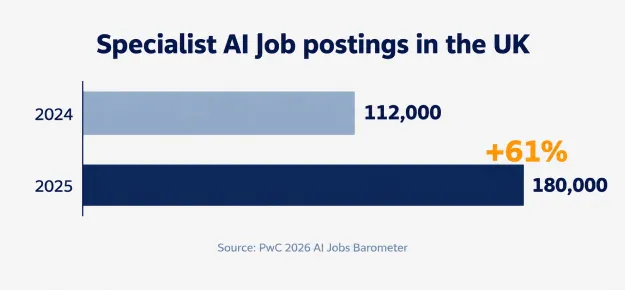
This image shows the graph in which the stats for Specialist AI job postings in the UK are shown for the years of 2024 and 2025

180,000 specialist postings

Specialist AI postings rose from 112,000 to 180,000 in 2025, returning to levels last seen in 2022.

2.2% of the UK job market

Specialist AI roles now make up 2.2% of the whole UK job market, up from 1.3% a year earlier.

A shrinking wider market

Overall UK vacancies fell 6.6% over the same period. Postings fell 11% between the start of 2026 and 17 July and sit 32% below pre-pandemic levels, with graduate postings at their lowest for the time of year since 2020.
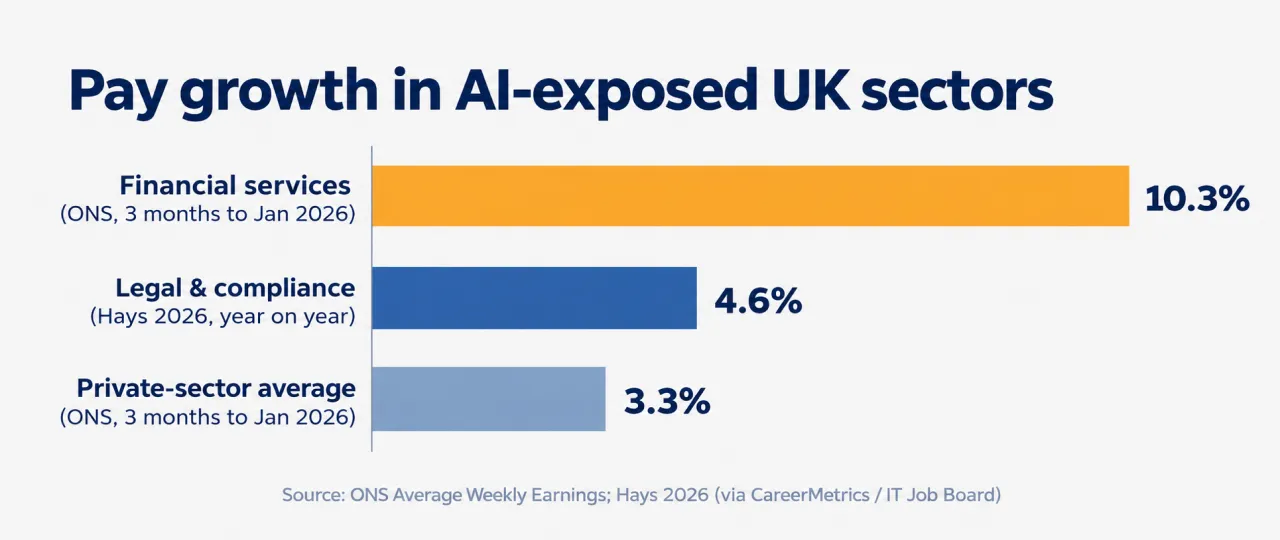
Financial services and legal & compliance lead AI

AI is reshaping pay well beyond the technology sector, and the shortage of AI skills (Insight 04) is showing up directly in salaries. Financial services, one of the sectors moving fastest to embed AI into trading, credit risk and client reporting, recorded pay growth of 10.3% in the three months to January 2026, more than three times the private-sector average of 3.3%, according to ONS Average Weekly Earnings data. Legal and compliance, not traditionally seen as an AI-driven sector, delivered the highest salary increases of any UK profession Hays tracked in 2026 (4.6% year on year), largely because employers are paying a premium for staff who can work alongside AI contract-review and discovery tools. The market is increasingly “two-speed”: software developer postings are rising again (+14%), while postings in roles more exposed to AI substitution, such as accounting and marketing, are falling by double digits.
Bar chart showing UK pay growth: financial services 10.3%, legal and compliance 4.6%, private-sector average 3.3%

AI is now the hardest skill to source, with 97% of UK organisations reporting a skills gap

AI has overtaken every other discipline as the single skill UK organisations find hardest to hire for. According to ManpowerGroup, AI was identified for the first time as the hardest skill to source, and roughly 97% of organisations report at least one AI-related skills gap. The shortage is not limited to AI itself: 57% of employers also cite technical shortages in programming and data science, skills that sit close to most AI work. For employers, this helps explain the pay premiums covered in Insights 01 and 03. For jobseekers and career changers, it shows where training in AI, programming and data science is most in demand.

01

AI-related skills gap

Organisations reporting at least one AI-related skills gap.

Listed in

97%

02

Technical shortages

Employers citing specific shortages in programming and data science.

Listed in

57%

03

Hardest skill to source

Employers naming AI as the hardest skill to hire for, a first for the survey.

Listed in

19%

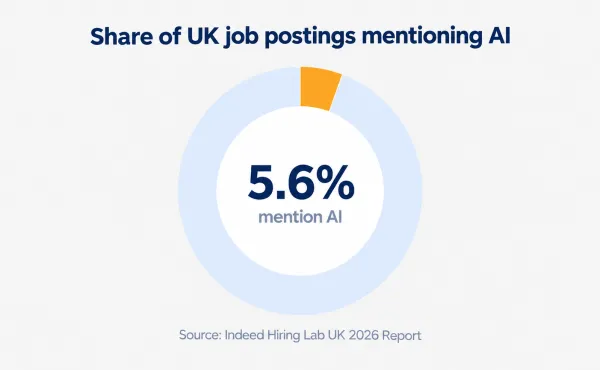
5.6% of UK job postings mention AI, the highest share of any major economy tracked

AI is no longer confined to specialist roles; it is becoming part of how everyday jobs are described. Indeed’s Hiring Lab finds that 5.6% of all UK job postings now mention AI or AI-related tools, the highest share of any of the 30 major economies it tracks. Growth is increasingly driven by “AI user” roles, where specialists apply AI within an existing field, rather than by AI developer roles, and AI is being written into a fast-growing share of tech job descriptions. The two blocks below show how far that shift has gone.
Donut chart showing 5.6% of UK job postings mention AI

The AI user majority

“AI user” roles, specialists applying AI within an existing field, grew 65.8% and now account for the majority of AI-related demand, rather than AI developer roles.

Embedded in tech roles

AI is now cited in 19.29% of jobs in the Processes & Methodologies category, up from 5.31% just two years earlier.

London leads UK AI hiring with 38.5% of permanent job ads, while Scotland matches its £85,000 median pay

AI hiring is concentrated in London but spread right across the country. Of the 10,062 permanent UK job ads citing AI in the last six months, London accounts for 3,877, and its median salary of £85,000 sits £20,000 above the rest of the UK (£65,000). Outside the capital, the North of England and the South East lead on volume, and several regions moved up ITJobsWatch’s demand ranking year on year, including the East of England (+16 places) and the North West (+10 places). Pay is rising in many of them too: the South East median is up 19.05% to £62,500, and Northern Ireland sits at £74,830.17 Roles advertised as work from home add a further 3,237 ads at a £70,000 median, so location matters less for some AI jobs than for others.
Highest volume
38.5%

London: 3,877 permanent AI job ads

London has the largest share of UK AI hiring and has climbed nine places in ITJobsWatch’s demand ranking year on year. Its median salary rose 6.25% over the same period.
Median Salary: £85,000
Regional hub
16.1%

North of England: 1,616 permanent AI job ads

The strongest hiring region outside London, ahead of the South East (1,235 ads at £62,500). Median pay is up 10% year on year across the North of England.
Median Salary: £66,000
High pay value
£85,000

Scotland: 296 permanent AI job ads

Scotland offers a London-level median salary from a much smaller pool of roles (2.9% of UK AI ads), with pay up 25.93% year on year.
Median Salary: £85,000

Where does this data come from and what does it mean?

This report brings together published figures from ITJobsWatch, Xcede, PwC’s 2026 AI Jobs Barometer, Indeed Hiring Lab, ManpowerGroup, the Office for National Statistics, Hays (via CareerMetrics and IT Job Board), UKRI and GOV.UK. Time periods differ by source and are stated beside each figure.
THE FOLLOWING ROLES AND ROLE TYPES ARE REFERENCED IN THIS ANALYSIS:

Machine Learning Engineer

Data Engineer

Analytics Engineer

Head of AI

Research Scientist

AI Developer

AI User Roles

Software Developer

AI Engineer

AI Architect

Role data source: ITJobsWatch job-title statistics for permanent UK jobs citing AI, six months to 7 October 2026. “AI Engineer” appeared in 701 of the 10,062 ads (6.97%) and “AI Architect” in 244 (2.42%). itjobswatch.co.uk

Use Job Market Insights to Plan Your Career in Tech or AI

Understand where the opportunities are and find the right route into IT or AI based on your skills, experience and career goals. 

Hear it from our Alumni

Contact Us

Get in Touch with our team

Ready to explore a career in IT? Speak to our team about the right programme and pathway for your goals. 

Admissions Hotline

+44 207 9934928

Average Response Time

Within 2 business hours

Submit your inquiry

Please fill out all required fields to help us route your request.

By submitting, you agree to our Privacy Policy and consent to receive admissions emails.